Fixing Servo Fetch BYOB response streams
How following the Fetch spec for BodyInit byte streams made constructed Response bodies readable with BYOB readers in Servo.
This is the second post in my Servo generational run series. This one is about a small Fetch API fix in Servo.
The patch itself is not big, but the failure was interesting because it was not in the BYOB reader code directly. It was in the way Fetch was creating response body streams.
The fix landed in Servo PR #45589.
A bit of context: I had already implemented BYOB stream support in Servo before this. So the problem was not that Servo had no BYOB reader support at all.
The BYOB reader path was there, and it was doing the right check. BYOB readers only work with readable byte streams. The issue was earlier than that: some Fetch body extraction paths were creating default streams instead of byte streams.
The failing test was:
Read text response's body as readableStream with mode=byob
It came from fetch/api/response/response-consume-stream.any.js. The same pattern also failed for URLSearchParams, ArrayBuffer, and FormData response bodies.
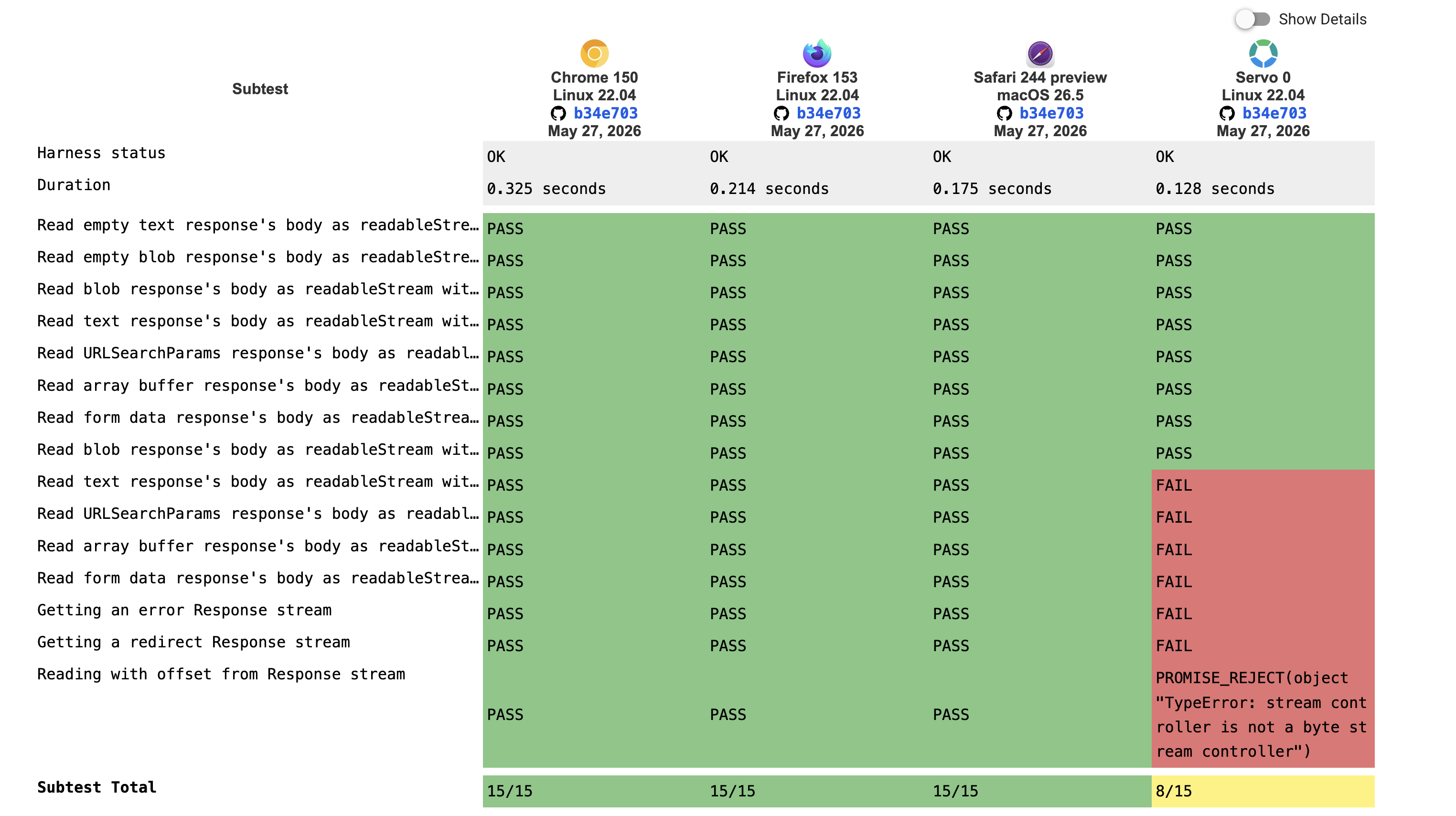
The important part is the reader mode:
response.body.getReader({ mode: "byob" })
BYOB means “bring your own buffer”. Instead of the stream allocating a new buffer for every read, the caller gives it a buffer to fill.
That only works when the stream is a readable byte stream.
Before the fix
Servo already had two helpers for creating a ReadableStream from bytes:
ReadableStream::new_from_bytes(...)
ReadableStream::new_from_bytes_with_byte_reading_support(...)
The first helper creates a normal default stream. It can still enqueue byte chunks, but the stream does not have a byte stream controller.
The second helper creates a stream with byte reading support. That is the kind of stream that can be read with a BYOB reader.
Before the fix, the text response path looked like this:
new Response("This is response's body")
-> BodyInit::String extraction
-> string bytes are created
-> Servo creates the body stream with new_from_bytes
-> response.body is a default stream
-> getReader({ mode: "byob" }) asks for a BYOB reader
-> Streams rejects it
Streams was right to reject this.
ReadableStreamBYOBReader should only be created for readable byte streams. If the stream has a default controller, rejecting a BYOB reader is correct.
So the bug was not in the BYOB reader validation. The bug was that Fetch body extraction was creating the wrong kind of stream.
The Fetch spec
Fetch’s BodyInit extraction algorithm says that for these byte-backed body sources, the stream should be set up with byte reading support.
That matters for:
USVString
URLSearchParams
BufferSource
FormData
byte sequence
Those are exactly the body kinds covered by the failing tests.
Blob was not part of this bug. Servo’s Blob stream already goes through the Blob get-stream path, and that path already uses byte reading support.
The missing part was the BodyInit extraction path for the non-Blob byte-backed inputs.
The fix
The patch added a small helper:
fn stream_from_body_init_bytes(
    cx: &mut js::context::JSContext,
    global: &GlobalScope,
    bytes: Vec<u8>,
) -> Fallible<DomRoot<ReadableStream>> {
    ReadableStream::new_from_bytes_with_byte_reading_support(cx, global, bytes)
}
Then the affected extraction paths were changed to use it:
BodyInit::ArrayBuffer
BodyInit::ArrayBufferView
Vec<u8>
DOMString
FormData
URLSearchParams
Before the fix, those paths created default streams:
ReadableStream::new_from_bytes(cx, global, bytes)
After the fix, they create byte streams:
stream_from_body_init_bytes(cx, global, bytes)
That changes the test path to:
new Response("This is response's body")
-> BodyInit::String extraction
-> string bytes are created
-> Servo creates the body stream with byte reading support
-> response.body is a readable byte stream
-> getReader({ mode: "byob" }) succeeds
-> the caller's buffer is filled
The important part is that this does not weaken Streams.
Streams still rejects BYOB readers for non-byte streams. Fetch now gives Streams the right kind of stream for these response bodies.
The test metadata
Once the implementation matched Fetch, these expected-fail entries were stale:
Read text response's body as readableStream with mode=byob
Read URLSearchParams response's body as readableStream with mode=byob
Read array buffer response's body as readableStream with mode=byob
Read form data response's body as readableStream with mode=byob
Reading with offset from Response stream
They were removed for both window and worker runs in:
tests/wpt/meta/fetch/api/response/response-consume-stream.any.js.ini
The result
The focused WPT run for response-consume-stream.any.js now has the BYOB cases passing in window and worker.
The shape of the fix is simple:
BodyInit bytes should produce a readable byte stream.
Readable byte streams can have BYOB readers.
Default streams still cannot.
The patch is small because Servo already had most of the stream machinery. The main work was finding the place where Fetch was using the default-stream helper instead of the byte-stream helper.